
Read Part 1 of this article here.
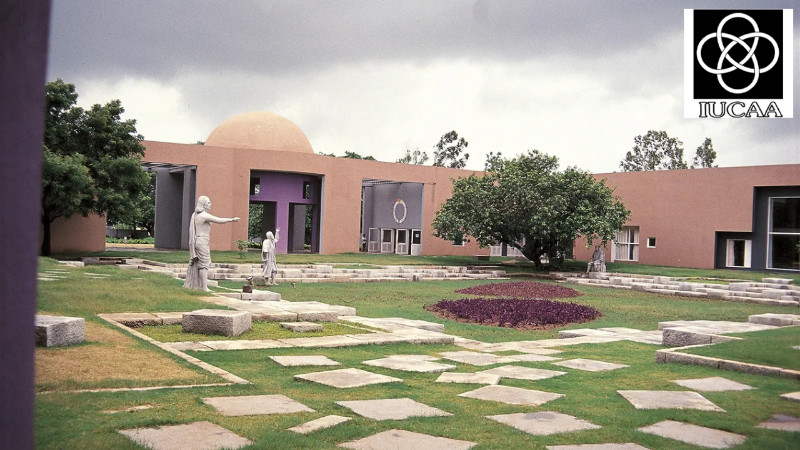
It was pertinent that astrophysics teaching and research should be promoted and strengthened in universities. IUCAA was thus conceived as a common university facility. Around the same time, Jayant Naralikar (JVN) was also thinking to move out of TIFR and looking for something challenging, and on the other hand, Yash Pal, ever hungry of new ideas and projects, was at the command in UGC. This was a very fortuitous circumstance that gave rise to the idea of IUCAA and JVN instantly took up the challenge.
Quasi Steady State Theory
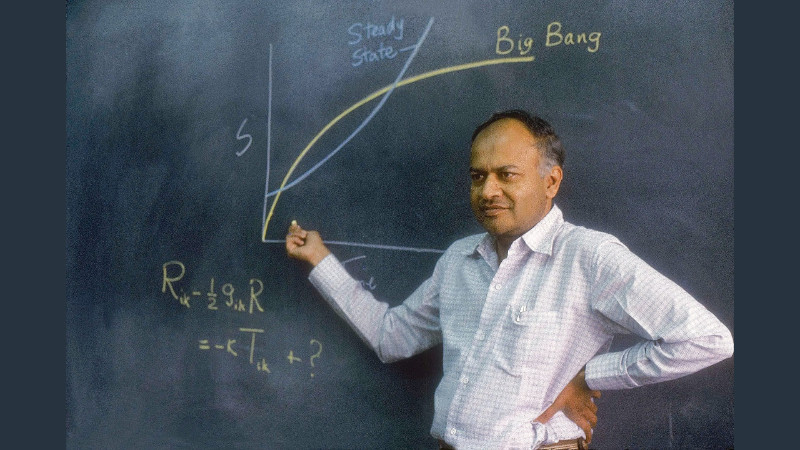
In response to the challenge thrown by the mainstream view – the party line, the famous rebellious trio, Hoyle, Geoffery Burbidge and Narlikar developed in 1993 the quasi-steady state theory of cosmology (QSSC) as their version of cosmology. One of the main issues was how to explain CMBR radiation which was by now a well established fact. True to his character, Hoyle responded to the CMBR observation quite differently than his friend and cofounder of SST, Hermann Bondi, and argued that star light could get polarized by dust in the universe to produce CMBR like effect. For that dust should be there at all times.
It was then envisaged that the Universe did not remain in steady state at all times but it went through cycles of very high dense state of high energy when matter got created, as it was done at the big-bang, it was then followed by normal expanding phase, followed by collapsing phase to highly dense state. This is how it is in the quasi steady state. It is a cyclical universe which goes through highly dense state resembling big-bang and then it bounces back to expanding state. Matter from one cycle in the form of dust is carried over to next cycle and that is how there is always dust required to polarize star light for creating a CMBR phenomenon.
That is how they had proposed QSSC. It is very creative and ingenious yet several cosmologists are doubtful if the special dust required by the theory exists. Although experiments have conclusively shown that metallic vapours do condense into whisker like forms – forming the kind of dust required for polarization of star light, yet the idea of its existence in space is considered incredible. It is ironical though that cosmologists have no qualms in accepting the presence of strange (non-baryonic) dark matter for which there is no laboratory evidence.
Steady state adhered to the most fascinating and beautiful conception in perfect cosmological principle which QSSC had to give up and thereby it lost all its aesthetic appeal. In QSSC, a big-bang like event is proposed continually and cyclically. It is now entirely driven by phenomenology and not by a compelling guiding principle. It was descending down from the pristine plane of concept and principle to machine shop of phenomenology. Above all the whole argument is quite laboured.
At the same time, a Universe in perfect steady state is an inert object with no change and evolution. It is the change that drives everything. A steady state has to be broken whether QSSC way or otherwise is the question.
The picture that emerges is as follows: The Universe gets on the creation mode as alluded earlier during the dense phase and as it expands settles down to the normal steady state mode creation gets switched off. Then after some time it goes through collapsing phase to get to high energy creative mode again, and so on the cycles go on indefinitely. In this process, there should also exist very old stars, who survived the collapsing phase, from the previous cycle and QSSC therefore predicts existence of stars older than the present age of the Universe according to the big-bang theory. This is a clear cut prediction but so far it remains unverified. If a star older than the Universe does show up, big-bang theory certainly goes whether people would accept QSSC or not would be a different matter. It is important for a theory to make a clear prediction that could be subjected to observational test. On this primary count, QSSC stands perfectly well.
They had to work very hard to get their viewpoint across and the situation was appropriately summed up by the Editor of Nature, John Maddox in the editorial comment, entitled, {\it The return of cosmological creation}: "...they (the trio - Hoyle, Burbidge and Narlikar of QSSC) at least deserve credit for having pointed to one way in which the Big Bang, an event without a cause, might be brought within a wider framework". This was an echo of Hoyle's words justifying the continual creation in the steady state theory about five decades back. It was some recognition of the effort and ingenuity of the three distinguished rebels. With both Hoyle and Burbidge being gone earlier, now the last one of the three as also gone, marking the end of the stead state era.
Science Sociology
Science is in the ultimate analysis is driven and validated by experiment and observation. Fundamental questions are conceived and formulated by adhering to concepts and principles, and then a model is constructed giving a wider framework in which new phenomena and questions could be addressed and formulated. The theory has to make definitive predictions that have to be verified by experiment to validate it. How so beautiful the idea be a theory like SST, if the observation does not agree with it, then it goes. This is exactly what had happened with SST.
The key unshakable principle that governs science is the conservation law – conservation of physical quantities like energy, momentum, etc. SST had required continual creation of matter out of nothing which violates the conservation of energy. This is the most abhorrent and repulsive feature of SST, and its outright rejection largely emanates from it. Big-Bang also violates the conservation law but only once in a singular event marking the limit of validity of the theory. Leaving aside that, it is all through consistent with the principle.
In contrast, SST the violation occurs continually, which one finds very hard to live with. In BBT, the event of invalidity is a singular and isolated while for SST it is so all the time and ever pervading.
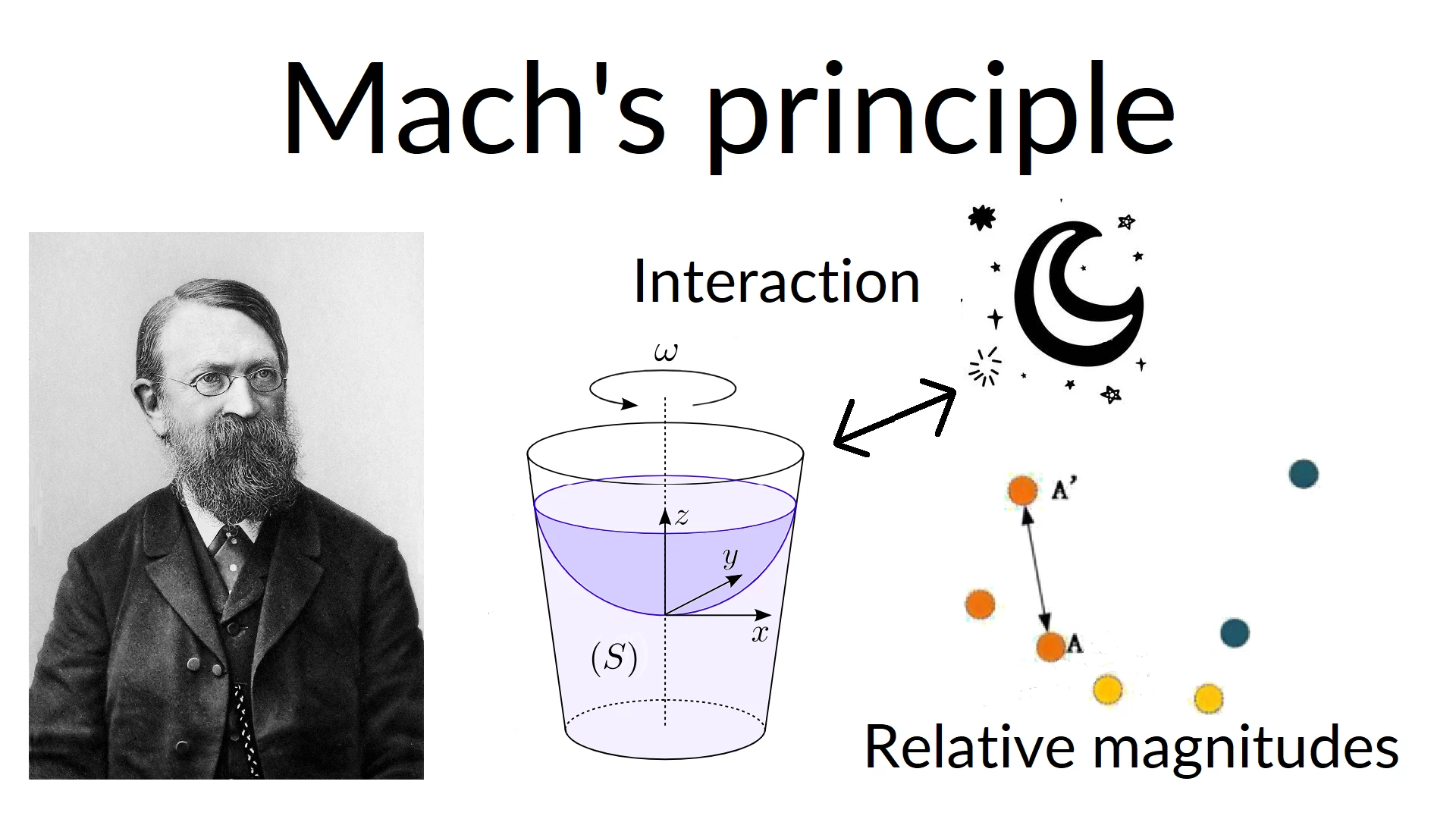 H-N theory of gravitation which had such an attractive feature incorporating the Mach’s principle also got side lined and ignored largely because it promoted SST cosmology. So is also the case with their theory of action at a distance incorporating gravity and obtaining the natural cut-off from the response of the rest of the Universe requiring no ever doubtable normalization. It is indeed a big step forward in quantum theory framework but it is SST that raises the red flag.
It is not true that such outlandish ideas are not invoked but they are not generally driven by observation. One such, the concept of inflation which prescribes that the very early Universe had to experience accelerated expansion so as to establish causal connection between its different parts. We have no clear understanding and explanation of this phenomena but it fits into the overall BBT paradigm and agrees perfectly with observation. Very outlandish ideas are flown around to explain dark matter and dark energy including that of phantom field which is no different from the energy conservation violating creation field of SST. So long s it conjures well with the overall paradigm, such ideas are accepted and further worked on.
By using the creation field of SST, Jayant was able to show that supermassive black holes could be formed in the centres of galaxies which was later also found by Donald Lynden-Bell and Martin Rees using the conventional matter.
This is how science sociology works. All that fits in the existing paradigm obeying the basic conservation laws and causality is accepted. The only when driven by strong phenomenology and hard observation, on is allowed to take liberty with the principles with the hope that it would some time lead to new insight and clearer understanding.
Jayant always stuck to the fundamental questions even when he was in ridiculous minority of one. Even though one did not agree with his viewpoint, yet there was a respect and consideration for him globally.
Notwithstanding the fact the seminal works of Hoyle – Narlikar theory of gravitation and action at a distance formulation of quantum theory based in SST are two outstanding pieces. More importantly the latter, quantum theory requires no normalization is certainly a great advance.
I believe science history would be more considerate and kind to the Hoyle-Narlikar duo.
IUCAA
The greatest gift he has given to the nation and to science in general and astronomy in particularly is IUCAA, a world class astrophysics centre for promotion and growth of astrophysics teaching and research in universities. It was the most fascinating and rewarding experience for me to work with him in building up this wonderful institute right from the conception. He has uncanny knack of making you share and be an equal participant in his dream and vision. There are few people who have this wonderful tact, the other person I have heard of was the founder Director, Kelkar of IIT, Kanpur, who would make even a security guard feel that how valuable he was to the institute. This is the key to getting best out of one's colleagues.
In mid 1980s Govind Swarup conceived GMRT and was looking for appropriate site for it, I played a midwifery role in helping him in the logistics for the site survey around Pune. In view of such major observational facility, it was pertinent that astrophysics teaching and research should be promoted and strengthened in universities. IUCAA was thus conceived as a common university facility. Around the same time, JVN was also thinking to move out of TIFR and looking for something challenging, and on the other hand ever hungry of new ideas and projects Yash Pal was at the command in UGC. This was a very fortuitous circumstance that gave rise to the idea of IUCAA and JVN instantly took up the challenge. Then rest followed beautifully.
Listen to an insightful discourse by Pandit Vidyasagar - विज्ञानाला मानवी चेहऱ्याची गरज हे विज्ञानाच्या अभ्यासातून कळले...
IUCAA is a fascinating story that would require an article for itself. Even at the risk of being self congratulatory, I have no hesitation in saying that it is not only a leading institute but it is also a novel experiment in institute governance and participative and democratic functioning. It follows the dictum of {\it trust breeds trust}. All the responsibilities including financial are shared by all the faculty members who actively participate in all decision making. Director has very little to do as I could vouch from my own experience. Once Ravi Kulkarni when he was Director of HRI phoned me, was it true that Narlikar spent only 25% of his time on administration as claimed in his last Director's report? I said that he was a great manager of his time but I would say that I didn't have to spend even that much. It is a testimony to the fact that a well geared responsibility sharing system has been evolved such that everything goes on smoothly and effortlessly without anyone getting hassled. It is a visitors institute and it entertains over thousand visitors a year, yet it is remarkable how everything is taken care of without any intervention from faculty members. It is to the credit of its support staff that visitors from all over pay very rich and affectionate compliments for hospitality offered to them. The key is to make everyone feel involved in whatever one is doing by giving functional freedom.
Another instance is in order to highlight his commitment to participative and democratic functioning. For faculty hirings, there is a screening committee of senior faculty, if found suitable then referees reports are sought and finally it comes to the selection committee. Once he proposed a name to be considered and sent a mail seeking for a meeting of the screening committee. We all said that the person did not make the grade, he got angry, and convened the committee meeting. We all spoke out our views which he patiently listened to, and then gracefully accepted our view by saying that he just wanted it to be deliberated in the meeting. This is one instance that stands as a sterling example of how true and committed he is to what he professes. Would it surprise anyone that why he enjoys such a trust and unflinching loyalty from his colleagues?
IUCAA is all set for big things and doing very well. Nothing could be more gratifying than running into a student from the Raipur University at one of the largest telescopes in the world in the ATACAMA Chilean desert. That's exactly what he had dreamt of IUCAA that the best astronomical facilities in the world should be accessible to an ordinary university student.
He has been a wonderful role model for four generations of young students who have grown up looking upto him. I heard very eminent people recalling with great fondness that their grand parents blessing them with a wish, be like Narlikar. Even when he laid down the reins of IUCAA steering it gloriously for the first 15 years of its existence, he has again set out an example, how should one detach from one's own creation with utmost grace and candour. He picked up an office in a quiet corner of the Library and Computer Centre block, and one sees him only at the tea time at 10.30, the time imprinted from the Cambridge days, in the Pendulum court. Else he is completely invisible, again there is something to emulate. It is remarkable that he never ceases to be a role model. He is indeed a gentleman scientist and a very wise man.
Here is a man who does outstanding research, works with missionary zeal to spread the message of science and its method to far and wide, writes books, gives lectures and builds up an institute, and also finds time to advise Government in advisory capacity through various committees, yet you never find him rushed and hassled. The secret is his peace of mind which is provided in abundance by this wonderful human being, his wife, Mangala. They are a very fine couple, simple and unassuming and ever ready to help. To put things in right perspective, on one hand the kind of adulations and admiration he received at a very young age of late twenties (and continues to receive) should have been very hard and demanding to digest and carry it along all through, and that he has done with remarkable grace and modesty in the best Indian tradition. On the other hand in his professional work feeling isolated and important contributions not being duly recognised by peers is also equally challenging to cope with. Again he has done it beautifully with grace, poise and without rancour. This is the real measure of him.
On personal count I should say that it has been the most fascinating and rewarding journey with him and should he ever signal for teaming up again even with a stretch of an eyebrow I would be by his side even before the stretch vanishes. In the ultimate reckoning it matters not whether one got one's due or not, what matters is how best you lived and worked notwithstanding the rewards and disappointments. Without hesitation I would say that Mangala and he have lived outstandingly well and on the coming July 19, his 86th birthday, I wish him to continue living well.
- Naresh Dadhich
nkd@iucaa.in
(Author is a physicist and former Director of IUCAA)
The Marathi Translation Of This Article was published in the Weekly Sadhana issue dated 9th August 2025.
Tags: Jaynt naralikar iucaa hoyle naralikar Mach Mach principle steay sstate theory big bang theory astrophysics physics research institute pune universty Load More Tags







Add Comment