
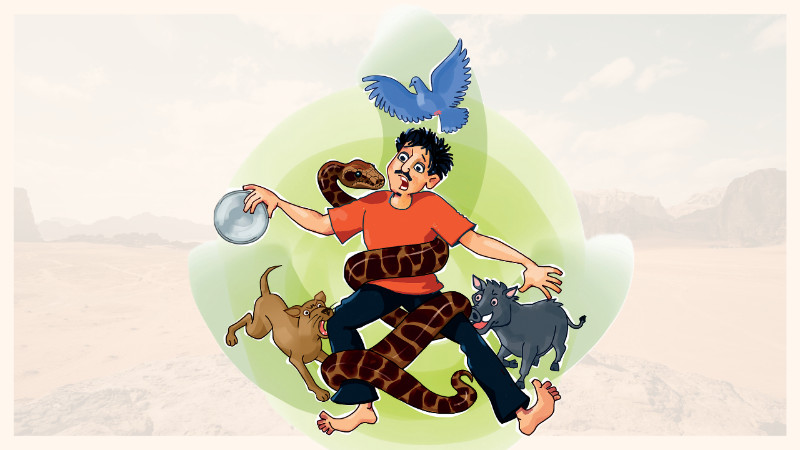
A pattern is now visible in wildlife conservation. Where earlier policies have succeeded and animal populations have grown, the next logical step must be population regulation. A striking example of this is wild pigs (boars). Their numbers have exploded, and they have begun attacking humans. In Kerala, there is widespread public anger against wild boars in over 50 legislative constituencies.... Environmental experts are demanding the withdrawal of protection granted to wild boars, but the central government remains unwilling.
Americans are, in a sense, peculiar in their habits. They are especially fond of keeping animals as pets. That, by itself, is quite ok. Millions of cats and dogs live comfortably in American homes. But pythons? Why would anyone choose to keep a python?
With dogs and cats, we form emotional bonds. We pet them, care for them, and they communicate with us through gestures, sounds, and behavior. A sense of relationship and attachment develops naturally. But what kind of bond can one form with a python? In India, even traditional snake handlers are not seen engaging with snakes through affection or emotional communication.
Nevertheless, about fifty years ago, some Americans began keeping baby pythons as pets.
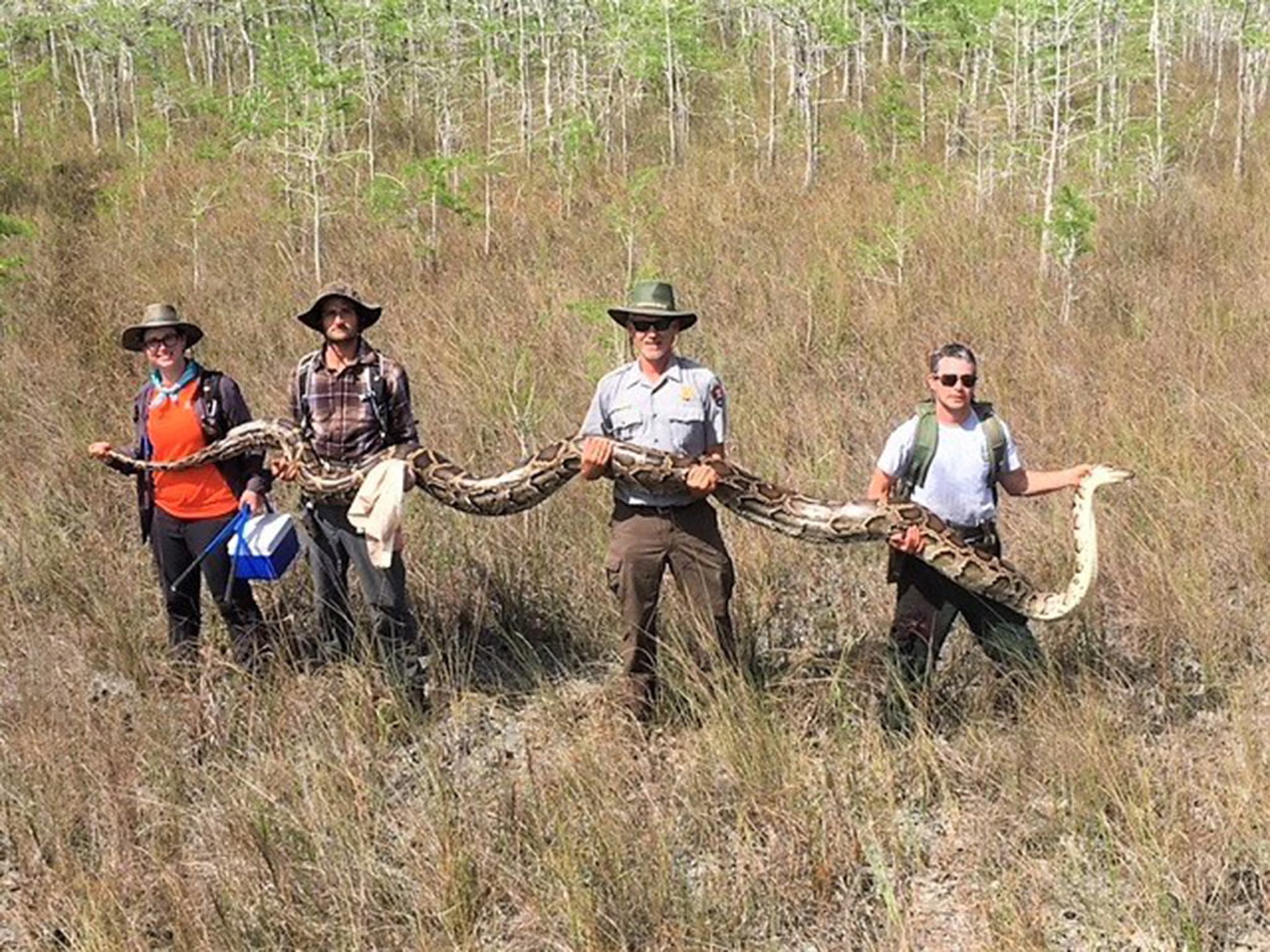
Over time, these pythons grew—some exceeding 20 feet in length. Their owners panicked. What does one do with such monstrous creatures? Many were released into the wild; some escaped on their own.
Florida’s forests offered ideal conditions for their survival: a warm, mild climate, extensive wetlands, no natural predators, and an abundant supply of prey—primarily deer and river otters Nature follows a simple law: when conditions are favorable, populations expand rapidly. And that is precisely what happened. These “guest” pythons spread swiftly across Florida’s forests. They wiped out deer and river otters. Eventually, even alligators fell prey to them.
Emboldened, the pythons began moving out of forests and into human settlements. The threat to human life increased. Population control became unavoidable.
The Florida government responded by encouraging python hunting and announcing financial incentives. The reward was determined by length:
$50 for the first five feet, and $25 for every additional foot.
Destroying a python nest earned a reward of $200.
An annual python-hunting competition was introduced, with total prize money of $25,000.
This year, a young woman—shorter than five feet in height—killed 60 pythons in a single week.
The lesson is clear.
When conditions are favorable, any species can multiply uncontrollably.
Maintaining ecological balance requires placing limits on excessive population growth.
About fifty years ago, India too began worrying about the declining numbers of wild animals and birds—and rightly so. This concern led to measures such as the Wildlife Protection Act. These were welcome steps, and as a result, the populations of several species increased.
However, new problems emerged. Unfortunately, policy flexibility is not our strong suit.
In 1955, inspired by the Soviet Union, India adopted a planned economic model. Over time, this gave rise to the monster known as the License–Permit Raj. Many sectors stagnated while the rest of the world moved ahead.
A once-poor country like South Korea joined the ranks of the world’s richest nations. We, meanwhile, remained trapped in a pit of our own making—until economic pressure forced change in 1991.
A similar pattern is now visible in wildlife conservation. Where earlier policies have succeeded and animal populations have grown, the next logical step must be population regulation.
 For Example, Pigs.
A striking example is that of wild pigs (boars). Their numbers have exploded, and they have begun attacking humans. In Kerala, there is widespread public anger against wild boars in over 50 legislative constituencies. Many farmers, exhausted by repeated crop destruction, have abandoned tapioca and pineapple cultivation. Even young rubber saplings are eaten, forcing a halt to new rubber plantations.
Environmental experts are demanding the withdrawal of protection granted to wild boars, but the central government remains unwilling.
Eventually, the Kerala government permitted selected hunters to cull boars. Over the past three years, an average of 2,000 pigs have been hunted annually. Yet, their population continues to remain stubbornly high.
In Maharashtra, standing sugarcane fields have become safe havens for wild boars. These fields provide food, water, and shelter in abundance. Here too, the time has come to regulate their numbers.
One concern is that if boar hunting is legalized, people may not stop at boars and may engage in indiscriminate hunting of other species. The solution lies in first acknowledging that the boar problem is real, and then taking controlled, experimental steps. I propose the following.
Traditionally, people in India consume their final non-vegetarian meal just before the start of Chaturmas, followed by four months of abstinence. On Gatari Amavasya, tons of chicken and mutton are consumed. Why not designate the last week of the month of Ashadha for boar hunting? Pork is considered delicious by most people (Muslims excluded). Let this special week become a controlled period for pork consumption, followed once again by a ban. Consider this proposal.
Now, Pigeons.
When one thinks of wild birds in India, the name that immediately comes to mind is Dr. Salim Ali—the sage-like ornithologist. The Bombay Natural History Society (BNHS) was founded by British officers, but it was Salim Ali who nurtured and shaped it throughout his life.
His autobiography, The Fall of a Sparrow, is enjoyable as well as educative reading. I recommend it strongly.
This introduction is meant to clarify that there is no reason to doubt BNHS’s intentions. Wildlife welfare has always been at the core of its mission. What, then, does the institution say about pigeons?
BNHS publishes a quarterly magazine called Hornbill, which carries content useful for general readers. In its April–June 2025 issue, there is an article titled “Pigeon Menace in Urban India”, written by Kishor Rithe, the current Director of BNHS. Rithe argues that the rapidly increasing pigeon population poses a serious threat to urban environments. Pigeons can transmit diseases such as bird flu. Their droppings dry up and turn into fine dust, which becomes airborne. When inhaled, this dust can cause fungal infections that may even reach the brain, leading to pneumonia-like illnesses.
In Mumbai alone, hundreds of people are suffering from severe respiratory diseases. The incidence of such ailments has increased fivefold over the past decade. The takeaway is unmistakable: there is no danger whatsoever of pigeons becoming extinct. Feeding them for religious merit is, in fact, counterproductive.
Responding to public complaints, the Maharashtra cabinet decided to shut down pigeon-feeding zones in Mumbai. This decision triggered considerable opposition. However, as early as 2016, the High Court had clearly ruled that activities causing public nuisance cannot be justified in the name of bird love.
BNHS offers clear guidance:
Do not express compassion for animals by dumping sacks of grain for pigeons. Instead, nurture native trees. Birds will then find food and shelter naturally.
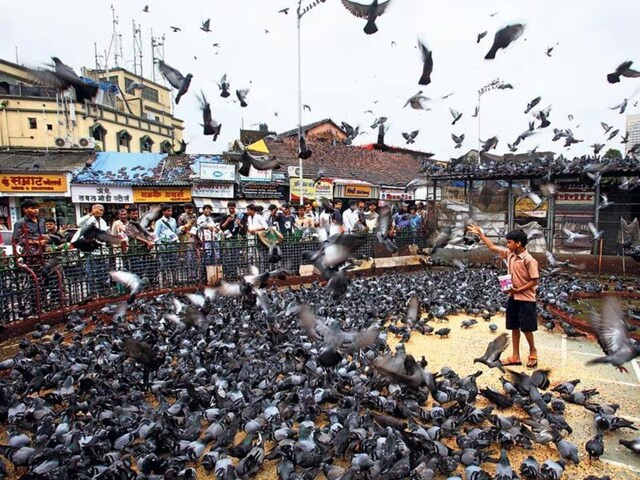 Members of the Jain community have voiced strong opposition to the closure of pigeon-feeding zones. I wish to address them directly. Friends, you are advocates of non-violence, and this commitment deserves respect. You spend your own resources on bird protection—an effort that is truly commendable. I myself am a student of Jain history and recite the Pancha Namokkar Mantra. In my view, your contribution to environmental conservation is invaluable. However, I urge you to direct your support toward species that are genuinely in distress.
In India, 99 percent of vultures have disappeared. We need millions of them. BNHS is working tirelessly on vulture conservation—support this effort. Every winter, millions of migratory birds arrive in India from the Arctic regions. Welcome them as hosts. We need all birds, not just pigeons.
Be wise. Practice non-violence with open eyes. Scattering grain indiscriminately is a form of lazy non-violence. Help thoughtfully, in the right places.
A shining example of such conscious action is the village of Kheechan in Rajasthan’s Thar Desert. Jain farmers here have, for generations, welcomed Demoiselle Cranes migrating from Siberia. They feed them generously. During winter, nearly 15,000 cranes gather here at a time. This tradition of hospitality has made Kheechan world-famous. Information about the village is available through YouTube documentaries; links are provided below. This model deserves emulation.
The extraordinary story of one village & 15,000 cranes
5 Most Stunning Crane Species with Majestic Plumage
Also Read - गोवंश हत्याबंदी कायद्यानं शेतकऱ्यांवर ओढवलेल्या संकटाची जाणीव करून देणारं पुस्तक (धनंजय सानप)
Finally, Dogs.
Stray dogs have multiplied across India. The reason is obvious: abundant food and the absence of natural predators. A population explosion is inevitable. What is the solution? Maneka Gandhi argues for humane measures—primarily sterilization. Perhaps the economic math has not been fully considered. India has an estimated 60 million dogs, half of them female. Sterilizing a single dog costs approximately ₹6,000. That translates to a total expenditure of ₹18,000 crore. This would leave veterinarians with insufficient time and resources for cattle, buffaloes, goats, and sheep.
Why incur such costs? Out of compassion? Then what about the millions of goats and chickens slaughtered every year? Should fishermen be asked to abandon their livelihoods? How would they survive? Emotion is important—it motivates action. But practicality is equally important—it provides direction. Emotion without practicality is sterile; practicality without emotion is like a ship without a rudder. The stray dog population must be regulated. Dog bites have already become a serious public health issue in India. Any dog that attacks humans must be eliminated.
In conclusion:
When conditions are favorable, the population of any species can grow uncontrollably. Our resources and energy should be focused on species heading toward extinction. Pigs, dogs, and pigeons must be approached in the same way we deal with rats, cockroaches, and mosquitoes. The usefulness of any species must outweigh the harm it causes. Otherwise, reducing its numbers becomes a necessity.
- Dr. Anil Gore
goreanil@gmail.com
(The author is a renowned Applied Statistician and Retired Professor of Statistics, Savitribai Phule Pune University, Pune)
The original article in Marathi featured as Coverstory of the Weekly Sadhana Issue dated 24 January 2026. It has been translated using an AI Tool, with a few manual modifications by the author.
Tags: ecology environment wild life protection peta animals pets animal population regulation wild life balance dr anil gore statistic Load More Tags




























Add Comment